Amêndoa do Algarve
Almonds grown across the Algarve's barrocal, the limestone hill country behind the coast, where almond trees have long been planted among fig and carob. Sold in shell or shelled, raw or toasted, eaten as a snack or ground into sweets.
How to order
Queria um quilo de amêndoas com casca, se faz favor.
Buyers say whether they want the nuts “com casca” (in the shell) or “descascadas” (already shelled), since stalls usually sell both side by side. Some ask for them “torradas” (toasted) rather than raw.
History
Almond trees grow across the barrocal between Loulé, Silves and Faro, planted alongside fig and carob on terraces of thin, stony soil that drains quickly after winter rain. The trees blossom in January and February, flowering before the leaves open, and the harvest falls in August and September, when growers shake the branches onto nets or tarpaulins spread beneath. The nuts dry in the sun for several days before the hard shells are cracked, by hand or machine, to free the kernel.
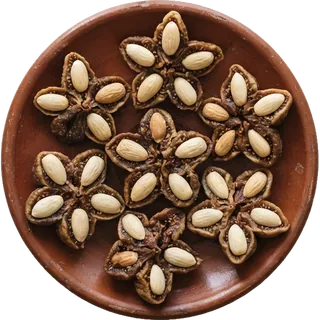
The almond is entirely a plant product, and nothing else traditionally goes into it before it reaches the table in shell or shelled form. No animal product has a traditional place here. Where egg enters Algarve almond cookery is a step further on: in morgados and other convent-style sweets, ground almonds are bound into a paste with egg yolks, which form the structural base of the sweet. The plain almond, sold at a market stall or taken straight from the tree, is never part of that mixture.
Where to get it
Found at market stalls in Loulé, Silves and Faro, and at roadside stands along the roads through the barrocal. Fresh-harvest nuts appear from late August, though dried almonds are sold through the rest of the year.