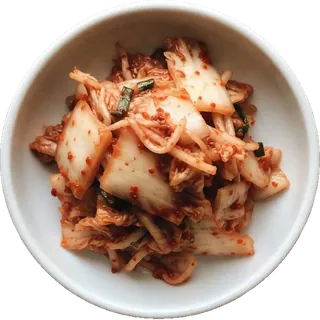
Baek-kimchi
Whole napa cabbage leaves are stuffed with julienned pear, jujube, chestnut and radish, then submerged in a clear, chilli-free brine rather than the red paste used for most kimchi. It is kept for children, for those who avoid spice, and made each kimjang season in Seoul and Gyeonggi-do households alongside the red kind.
How to order
백김치 젓갈 안 넣고 만든 걸로 주세요.
Jeotgal is usually stirred into the brine or stuffing before the cabbage goes into the jar, and some batches use beef bone stock as the brine base instead of salted water; both are fixed by the time the kimchi is served, so ask at the counter: “백김치 젓갈 안 넣고 만든 걸로 주세요.” A shop or household with only one batch on hand that day may simply not have a version without it, so this works best at a market stall or home kitchen that makes small batches to order.
History
Baek-kimchi (백김치) is kimchi made as it was before chilli pepper reached Korea in the seventeenth century, carried in through Japan after Portuguese traders brought it to East Asia. The cabbage is salted, stuffed with julienned pear, jujube, chestnut and radish, and covered in a clear brine instead of red paste. The style is tied to Kaesong, historically part of Gyeonggi-do, and to the Joseon royal kitchens of Hanyang, now Seoul. After Kaesong fell to the North, families who resettled in Incheon and across Gyeonggi-do kept making it, set aside for children and for kimjang tables each winter.
The base is pear, jujube, chestnut, radish and salted cabbage in a clear liquid, without the gochugaru paste that carries jeotgal (젓갈) into most red kimchi. Even so, many baek-kimchi recipes stir a spoonful of jeotgal, salted shrimp or anchovy, into the stuffing or brine for savour, and some households build the brine itself on sagol-yuksu, beef bone stock, rather than salted water. Both are mixed in during preparation, before the jars are sealed, and cannot be lifted back out once the kimchi is served. What has to be settled, before the jar is opened, is whether either went into that particular batch.
Where to get it
Banchan shops and kimchi markets in Seoul, including Gwangjang Market, sell baek-kimchi year-round by the container, though most households still make their own each November during kimjang; a 1kg tub runs 8,000-12,000 won, more in the Gyeonggi-do towns known for the Kaesong-style stuffed version.