Loz Omani
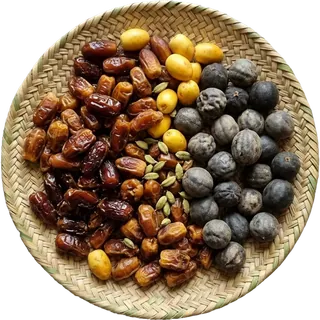
Almonds grown on the stone terraces of Jebel Akhdar and in the wadi gardens below, cracked by hand and eaten alongside dates and coffee, or ground into halwa.
How to order
أبي لوز عماني مع القهوة والتمر، لو سمحت.
There is no animal ingredient in almonds, dates or coffee to ask about; the only thing worth confirming is freshness, since Jebel Akhdar almonds are prized for being this year's crop rather than held over from the last.
History
Loz Omani are the almonds of Jebel Akhdar, grown on the mountain's stepped stone terraces and in the gardens that line the wadis beneath it. The trees flower white in February, and when the nuts come in they are cracked by hand, one at a time, rather than by machine. They are eaten plain alongside dates and coffee, or ground down to make halwa.
There is no animal ingredient anywhere in this: the almond, the date and the coffee are each plant on their own, with nothing added to any of them. What is worth noting instead is the terrace itself — the almond trees share the same narrow stone-walled plots as roses and pomegranates, irrigated by the falaj channels that have carried water down from the spring source for generations, so the February blossom marks the turn of the mountain's growing year as much as it marks the almond crop.
Where to get it
Village stalls and gardens on Jebel Akhdar, and markets in Nizwa, in the weeks after the February bloom and through the harvest that follows.