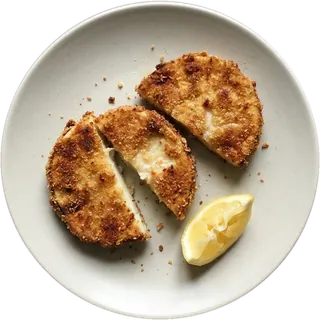
Vegetarisches Wiener Schnitzel
The Schnitzel without the calf — a breaded, fried slice of celeriac or vegetable loaf, made famous by Vienna's vegetarian restaurants around 1900.
How to order
Ist das vegetarische Schnitzel ohne Ei paniert und in Öl gebacken?
Ask whether the panade uses egg and whether the frying fat is oil rather than Butterschmalz; the side salad dressing may contain cream.
History
Vienna had a vegetarian scene a century before the current one. The Ramharter bakery began serving a vegetarian midday table in 1877 and opened Austria's first vegetarian restaurant; the Verein für naturgemäße Lebensweise, later the Wiener Vegetarierverein, followed in 1881, and the city hosted the first Vegetarier-Congreß in September 1886. Around 1900 roughly five vegetarian restaurants were operating in the city, up to eight by the 1920s.
The best known was the Thalysia, opened by Ignaz Langenecker in spring 1883 beside the Burgtheater, as much a lecture hall for the movement as a restaurant — in 1900 the Neues Wiener Journal reported on his talk 'plant food as an unsurpassed substitute for meat'. The Technisches Museum credits Langenecker with the creation that made him famous around 1900: a vegetarian Wiener Schnitzel. Middle-class converts came for conviction; badly paid workers came because it was cheaper than meat.
What makes the dish is the breadcrumb coat and the hot fat, not the egg that normally glues it on. Plant milk with mustard or flour holds the crumbs, and frying is in oil — which is how Vienna's vegan kitchens serve their Schnitzel today, from celeriac, oyster mushroom or soy.
Where to get it
Vegan and vegetarian restaurants across Vienna, and increasingly on ordinary Gasthaus menus.