Byrek me Hithra
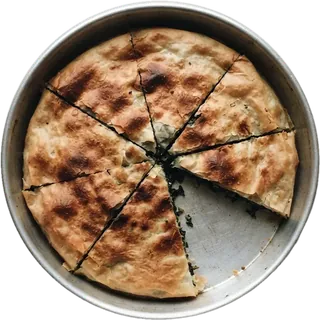
Nettles picked with gloves in March, before they flower, are blanched, chopped with onion and rice, and layered between thin pastry sheets baked under a metal lid. It is made in the highland villages of Dibër and around Korçë, eaten as the first fresh green dish after a winter of stored beans and potatoes.
How to order
Një copë byrek me hithra, pa vezë e pa gjizë, ju lutem.
Ask for it “pa vezë e pa gjizë, me vaj” — without egg or curd, with oil — since household versions often add one or the other to the filling. If the pastry sheets have already been brushed with butter before baking, that can't be changed once the pie is in the tray.
History
Hithra (nettle) is picked in March before it flowers, in the hill villages of Dibër and around Korçë, where women go out with gloves and a sack along ditches and field edges. The leaves are blanched to kill the sting, chopped fine, and mixed with onion and rice, then layered between thin pastry sheets and baked like other byrek. It appears in the weeks before Dita e Verës, when the autumn zahire of beans and potatoes is running low and nettle is the first green food of the year. Foraging for it continued through the collectivised years of the communist period, when little else grew fresh in March.
The filling itself is plant-based: nettle, onion, rice, flour, oil. The question is the pastry and what else goes into the tray. Many bakers brush gjalpë (butter) or ajkë between the sheets for colour and crispness, and some household versions add gjizë (curd cheese) or an egg beaten into the filling to bind it, in the same way other byrek take cheese or egg. None of that is needed for structure — the rice already does that job — so asking for byrek me hithra pa vezë e pa gjizë, me vaj, settles it before the tray goes into the oven.
Where to get it
Bakeries and village kitchens in Dibër and around Korçë, in March and the weeks leading up to Dita e Verës in mid-March, when nettle is in season; a slice at a bakery counter runs 50-80 lekë.