Chou à Choucroute
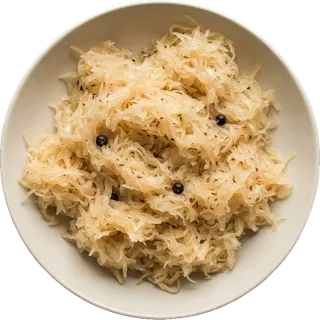
Dense white cabbage grown on the clay soils around Krautergersheim, cut in autumn and sliced within hours into oak barrels with salt, where it ferments into choucroute over several weeks. Krautergersheim, in Bas-Rhin, still calls itself the capital of sauerkraut and holds a cabbage festival each September.
How to order
Un kilo de chou à choucroute, s'il vous plaît.
The cabbage itself, raw or fermented into plain choucroute, carries no animal product, so nothing needs to be checked when buying it that way. The question only arises once it has been cooked into choucroute garnie with sausages and pork; to get it without, ask for “de la choucroute nature, sans viande.”
History
The cabbage is grown on the clay-rich plains of Bas-Rhin around Krautergersheim, a village of about two thousand people a dozen kilometres south of Strasbourg that has called itself the capital of sauerkraut since the nineteenth century. Its Alsatian name, Chou à Choucroute, is also its French name. Growers cut the dense white heads by hand in September and October and truck them straight to the village cooperative, where small family plots were consolidated over the twentieth century as farming industrialised; there the cabbage is shredded and packed into oak barrels with salt within hours of harvest, before it has time to wilt.
The cabbage itself carries nothing animal: it is sliced, salted and left to ferment in its own brine, a process of lactic fermentation that needs only the cabbage and the salt. Animal product enters later and elsewhere, when the fermented choucroute is cooked as choucroute garnie, layered with sausages, smoked pork and sometimes goose or duck fat in restaurants from Strasbourg to Colmar. Bought as a cabbage, at the cooperative or at market, it is naturally vegan and nothing needs to be asked.
Where to get it
The cooperative shop in Krautergersheim, Bas-Rhin, and its Fête du Chou each September, plus market stalls across the department from late August into November; fresh cabbage runs €1-2 a kilo, raw choucroute by weight around €3-4 a kilo.