Germknödel
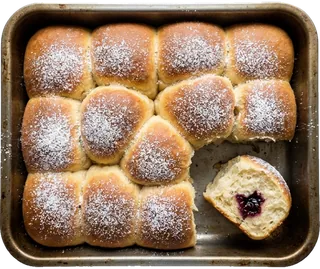
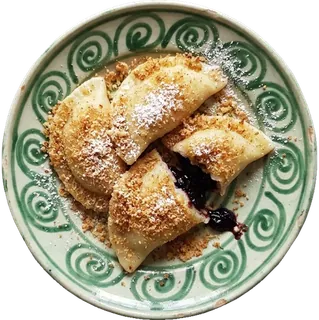
A fist-sized steamed yeast dumpling filled with powidl, drowned in melted butter and buried under ground poppy seed and icing sugar.
How to order
Gibt es den Germknödel vegan — mit Pflanzenmilch im Teig und ohne Butter drüber?
Ask for the dough without egg and milk and for oil or plant butter instead of the melted butter; the poppy and sugar topping is already plant-based.
History
The word first appears in print in Katharina Prato's 1879 edition, where she boils the dumplings and — a novelty — serves them with powidl. The same year Marie von Rokitansky prints 'Bohemian Germknödel filled with poppy seed', which is probably where the story of its Bohemian origin begins; the bible of Bohemian cooks in Vienna, Rettigová's Domácí kuchařka, has no filled yeast dumpling at all. What did change everything was industrial baker's yeast, developed in Vienna around 1850 by Adolf Mautner and Ignaz Reininghaus.
It is a Mehlspeise in the old sense — a meatless main course, ordered from the confectioner for Friday fast days, and today the standard midday meal on every Austrian ski hut.
Dough, powidl, poppy seed and sugar are the dish. Milk and egg in the dough and the flood of melted butter on top are what make the usual version non-vegan; plant milk in the dough and oil or plant butter over it leave the dumpling intact, and ski huts increasingly offer exactly that.
Where to get it
Ski huts and Gasthäuser all over Austria, and Mehlspeis kitchens in Vienna.