Heidensterz
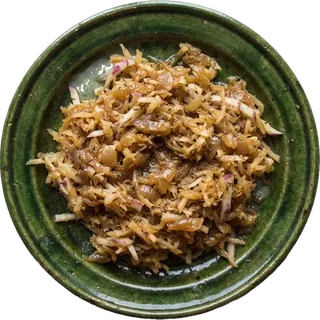
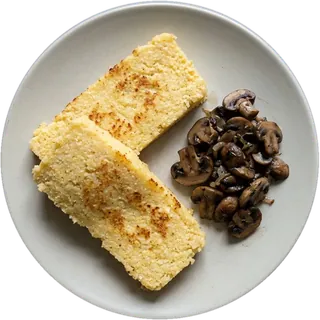
Buckwheat meal dry-roasted until it smells of nuts, scalded with boiling water and torn into crumbs — for centuries the daily food of Carinthian and Styrian farms.
How to order
Kann man den Heidensterz mit Öl abschmalzen und die Schwammerlsuppe ohne Rahm machen?
Ask for oil instead of lard or butter over the Sterz, no Grammeln or Verhackert on top, and a clear rather than creamed mushroom soup with it.
History
Buckwheat is not a cereal but a knotweed, and it came to Carinthia from Southeast Asia by way of the Mongols, the Tatars and northern Italy at the turn of the 14th to 15th century. Its cultivation there is documented in 1442 and 1445 around Villach and named in the tithe order of Archduke Karl II of Inner Austria; the Drautal, Gailtal and above all the Jauntal grew it in quantity. Austrians call buckwheat Heiden or Hadn, a name it got because the grain was thought to have come from distant lands. In the 16th and 17th centuries it was the leading actor in the Carinthian farm kitchen.
The dish made from it was simply what people ate. Mathias Lexer's Kärntisches Wörterbuch of 1862 defines Sterz as a national dish of buckwheat; in Styria Stephan Benditsch wrote in 1808 that Heidensterz was also a favourite food in Graz, and around 1900 Heidensterz and Kukuruzsterz together counted as Styrian national fare. It was eaten with coffee in the morning, with soup at midday, with sweet or sour milk in the evening. Today the Jauntal is the main growing area again, with its own buckwheat mill and an annual Hadn festival, and the dish is served with Schwammerlsuppe — mushroom soup — in Gasthäuser across both provinces.
Flour, water and salt are the entire structure, and the roasting step needs no fat at all. What makes the usual plate non-vegan is everything around it: lard or hot butter poured over, Grammeln or Verhackert stirred through, a mug of buttermilk alongside, or mushroom soup made with cream. Ask for it abgeschmalzen with oil and served with a clear mushroom soup and the dish is unchanged.
Where to get it
Gasthäuser and mountain huts in the Jauntal, Drautal and Gailtal in Carinthia and across upper and western Styria; the Hadn festival and Hadnzentrum in the Jauntal sell the flour.