Jinshan Digua
Jinshan digua is sweet potato grown on the volcanic soils of Jinshan on New Taipei's north coast, mostly the red-fleshed Tainong 66, dug at the end of summer and eaten roasted, steamed, or cooked through rice and porridge.
How to order
老闆,請問紅心地瓜怎麼賣?
Roasted or steamed sweet potato is plant throughout, so nothing needs checking at a stall; the doubt only arises in dessert shops, where a bowl may be finished with condensed milk, and 「不要加煉乳」 settles it.
History
Jinshan is the largest sweet potato district in New Taipei, with more than ninety hectares planted and around 1.6 million kilograms lifted a year. The fields sit below the Datun volcanic group on half-sandy clay formed from volcanic ash, watered by springs off Yangmingshan and crossed by salt-carrying sea wind, which local growers credit for the fine, dense texture. Cuttings go in from April, and the crop is dug from the middle of August to the end of September, selling on into October. Two varieties dominate: Tainong 66, the red-hearted type rich in carotene, and Tainong 57, the golden one usually roasted. Harvest-time kiln-baking events are held in the fields, and the district counts sweet potato among its three local crops with water bamboo and taro.
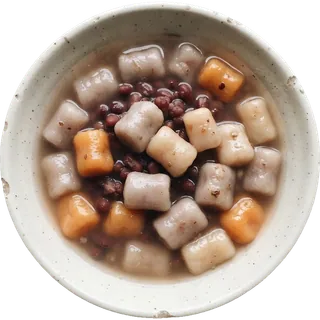
A sweet potato is a root, and roasting or steaming it adds nothing: the sweetness that butter or condensed milk supplies in other desserts comes from its own starch turning to sugar in the heat, which is why the roasted ones need no seasoning at all. The same holds for sweet potato cooked into rice or porridge, for the sweet soup made with brown sugar, and for the fried crisps and balls made from the crop. An animal ingredient appears only where a café or dessert shop finishes a bowl with condensed milk, cream or butter, so a diner asks for it plain or takes it roasted from the stall.
Where to get it
Jinshan Old Street and the Jinshan District Farmers' Association sales centre sell the crop fresh from mid-August to the end of September, alongside the Jinshan market where sweet potato, water bamboo and Tiaoshi taro overlap in autumn. Growers also take it to the Taipei Hope Plaza market by Shandao Temple station and to the Banqiao farmers' association square.