Koe'sister
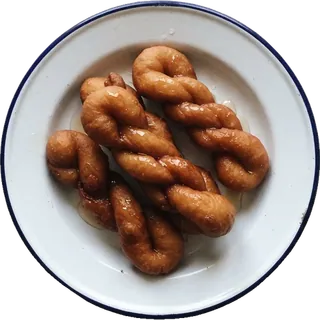
A yeasted dough spiced with cinnamon, ginger and aniseed, cut into small pieces, fried until golden, then dropped straight from the hot oil into cold sugar syrup and rolled in desiccated coconut. Cape Muslim households in Bo-Kaap and Athlone fry batches before dawn on Saturday night for sale after Sunday morning prayers.
How to order
Kan ek asseblief 'n koesister kry sonder botter, melk of eier?
Butter, milk or egg go into many family recipes at the mixing stage, so the dough has to be asked about directly: “Is daar botter, melk of eier in die deeg?” Most Bo-Kaap and Athlone sellers answer in English as readily as Afrikaans.
History
Koe'sister is a Cape Afrikaans name, the word used in Bo-Kaap, Athlone, Rylands and across the Cape Flats to mark it apart from the plaited, syrup-soaked koeksister of Afrikaner farm kitchens. Cape Muslim women fry the dough on Saturday night, timing batches so they are ready to sell from the front gate, at the mosque gate after Fajr, or house to house, before Sunday breakfast. The community that makes it traces to people enslaved and exiled to the Cape by the Dutch East India Company from Indonesia, Malaysia, India and Madagascar, and the Sunday koesister round remains a fixture of Cape Muslim family life.
Flour, yeast, sugar, aniseed, cinnamon, ginger, naartjie peel and desiccated coconut are all plant, and a dough made from nothing else fries and syrups the same way. Where butter, milk or egg appear, they go into the dough itself at the mixing stage, not added afterward, so the question has to be put to the cook or stallholder before the batch is fried, not settled once it is in the syrup.
Where to get it
Home kitchens, fundraising stalls and small shops in Bo-Kaap, Athlone and Rylands sell koe'sisters from Saturday evening through Sunday morning, the main hours for the trade; a dozen typically costs R40 to R60.