Slaptjips
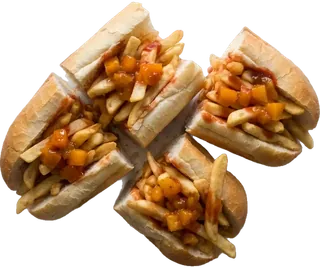
Potatoes are cut thick, fried twice until soft rather than crisp, then doused in vinegar and salt and wrapped in paper. Cape Town's fish and chip shops serve them this way at lunch and after dark, alongside fried fish or on their own.
How to order
Kan ek 'n sak slaptjips kry, asseblief?
Most Cape Town chip shops now fry in sunflower or canola oil, but it is worth asking outright: “Word julle tjips in dierevet gebraai, of is dit plantolie?” (“Do you fry your chips in animal fat, or is it vegetable oil?”). The other point to settle is the spice shaker, since some bottled chip spice contains milk powder: “Is die tjips-kruie vleisvry?” (“Is the chip spice meat-free?”). Many harbourside takeaways in Cape Town run the counter in English rather than Afrikaans, so either question works just as well asked in English.
History
Slaptjips, Cape Afrikaans for limp chips, comes from Cape Town's fish and chip trade, long worked by Cape Muslim and Coloured families in harbour towns such as Kalk Bay and Fish Hoek and in the city's inner suburbs. Potatoes are cut into thick batons and fried twice, first to cook through, then again until the surface softens rather than crisps, so the chip bends instead of snapping. The potato and the frying method reached the Cape through British colonial trade and settlement. Today slaptjips are an everyday lunchtime and late-night food, sold from corner takeaways and harbourside counters, eaten by hand straight out of the paper, doused through with vinegar.
The potato, the oil, the vinegar and the salt in a packet of slaptjips are all plant in origin; the chip itself has nothing animal in it at nearly every stall in Cape Town now, since sunflower or canola oil has mostly replaced the beef dripping some older British-style chip shops once fried in. What has to be checked is the seasoning offered alongside: some bottled chip spice and some vinegar substitutes include milk powder or animal-derived flavouring, so it is the shaker, not the chip, that needs confirming before it goes on the paper.
Where to get it
Harbourside takeaways and corner cafes in Kalk Bay, Fish Hoek and central Cape Town sell slaptjips from midday into the evening. A bag runs roughly R25 to R40 depending on size.