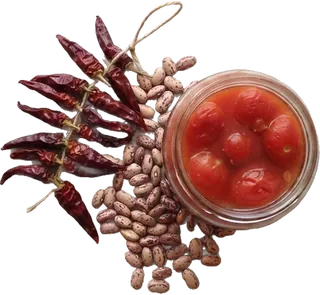
Komposto
Quince, plum, pear and cherry from the orchards around Korçë are put up in glass jars with sugar and water through July and August, then opened through the winter as part of the zahire that carries a household to spring.
How to order
Një kavanoz komposto kumbullash, ju lutem.
Ask whether the syrup was made with sheqer (sugar) or mjaltë (honey) — “A e keni me sheqer apo me mjaltë?” — since the sweetener is fixed once the jar is sealed and boiled, and a jar made with honey cannot be changed afterward.
History
Komposto belongs to the zahire, the household stock of preserved food laid in before winter; under communism, when shops ran short and most families grew or kept what they ate, filling a cellar with jars each summer was not a choice but a necessity, and the habit held through the shortages of the 1990s collapse. It is made wherever there is a garden or orchard — the plum and quince groves around Korçë, courtyards in Tiranë's blocks of flats, villages across both qarks. Through July and August fruit is picked, packed into washed jars with sugar and water, and sealed by boiling the filled jars in a tub.
The preserve itself holds nothing from an animal: fruit, water and a sweetener make up the whole recipe. The sweetener is where it varies — most jars are made with sheqer, white sugar, but in mountain households and around Korçë's beekeeping villages some cooks sweeten the syrup with mjaltë, honey, instead, a product of the bee rather than the orchard. The two cannot be told apart from outside the jar, and once a batch is sealed and boiled the sweetener is fixed for the winter, so it is worth asking at the point of buying or receiving a jar which one went in.
Where to get it
Household sellers and farmhouse stalls around Korçë, especially toward Voskopojë and the villages of the Korçë plain, sell jars through autumn and winter at 200-400 lekë each; in Tiranë they turn up on fold-out tables at the Pazari i Ri rather than in supermarkets.