Lentille Blonde de la Planèze
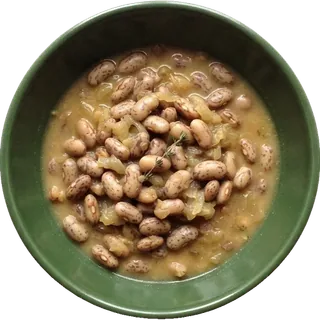
A small pale lentil grown at around 900 metres on the volcanic Planèze plateau above Saint-Flour, in Cantal, where thin soil and altitude slow its growth and sweeten it. It is harvested in late summer and eaten through the Cantal winter, from Saint-Flour's market to farmhouse kitchens on the plateau.
How to order
Une assiette de lentilles sans le petit salé, s'il vous plaît.
Ask before the pot goes on, since the salt pork is usually simmered with the lentils from the start, not added at the table: say “Une assiette de lentilles sans le petit salé, s'il vous plaît.” At a market stall selling the dried lentil itself, nothing needs asking, as it is sold plain and uncooked.
History
The lentille blonde grows on the Planèze, a basalt plateau above Saint-Flour in Cantal, at 900 to 1000 metres, where volcanic soil and cool nights give it a thin skin and a mild, sweet taste. Sown in spring and harvested by August, it was once a staple crop of the plateau's small farms, but postwar rural depopulation and the shift to cereals and livestock nearly ended it by the 1960s. A group of growers replanted it in the 1990s, and it now carries a protected geographical indication, sold at Saint-Flour's Saturday market and cooked in farmhouse kitchens through autumn and winter.
The lentil itself is plant only, but the standard Cantal recipe simmers it with a piece of salt pork, sometimes a smoked knuckle of bacon, added directly to the pot for the length of the cooking so its fat and salt pass into the broth. At a market stall or a cantine the pork is usually already in the water before the lentils go in, which makes it a question to settle at the counter rather than at the table, by asking for a portion cooked separately in stock or water alone.
Where to get it
Saturday markets in Saint-Flour and Murat, Cantal, where the dried lentil is sold loose by the kilo, roughly €6-€8; farm inns and small restaurants on the Planèze serve it as a plat du jour, usually with salt pork, for €12-€15.