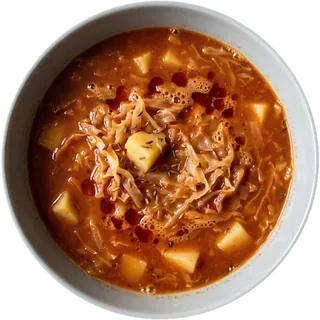
Letscho
White pointed peppers, tomatoes and onion stewed down in their own juice with sweet paprika until thick — the Hungarian summer dish that Burgenland made its own.
How to order
Gibt es das Letscho auch ohne Wurst und ohne Ei, in Öl statt in Schmalz geröstet?
Ask for it without sausage and without eggs stirred through, and for the onions fried in oil rather than lard; the vegetable base is cooked the same way either way.
History
Lecsó is younger than it looks. Peppers came to Hungary with the Ottomans in the 16th century and tomatoes later still, but both only became available in the quantities the dish requires after Bulgarian-style market gardening took off in the 1880s. The word itself is first recorded in 1914, as a dialect term from Diósjenő meaning green peppers with tomato. From 1924 the Globus cannery in Budapest exported it in tins, which is how much of Central Europe first met it. Whole villages cooked their winter supply in a kettle, and some places still hold a Lecsó festival.
Burgenland belonged to the Kingdom of Hungary until 1921 and inherited the dish with everything else — the paprika, the kettle cooking, the Croatian and Hungarian minority kitchens. Austrian food writing counts Letscho among the fixed points of Burgenland cooking alongside Krautsuppe and Erdäpfelgulasch, and in Vienna the dish picked up a second life in the Jewish kitchen, where a 1993 WIZO cookbook prints a „Bulgarisches Letscho“. The lard-and-bacon version that Franz Maier-Bruck recorded in Vom Essen auf dem Lande is the Austrian country variant.
The original is three vegetables, salt, pepper and paprika powder, cooked without added water. The Lecsókolbász that now seems obligatory is, by the Hungarian account, not an original tradition but a development of recent decades; the eggs stirred in at the end and the lard the onions are fried in are the other two animal ingredients. Onions started in oil and nothing added at the end gives the dish as it was first written down.
Where to get it
Gasthäuser and Heurige throughout Burgenland in late summer and autumn, and at the Seewinkel vegetable markets when the peppers come in.