Mixiang
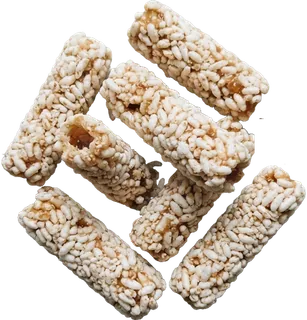
Rice puffed in a pressure vessel, stirred hot into boiled maltose and pressed flat in a tray, then cut into blocks. It is made across rice-growing Taiwan and sold in Lukang in Changhua County.
How to order
老闆,米香一包。
The usual doubt is butter, which is standard in popcorn but not here: mixiang is bound with grain maltose and sugar. Confirm the flavour has nothing added by asking 「這個是純米跟麥芽嗎?」
History
Rice goes into a sealed rotating pressure vessel over a flame; when the lid is released the water in each grain flashes to steam and the grains burst with a bang that gives the street version its Taiwanese name, pong-bi-phang. The puffed rice is tipped into boiled maltose, turned fast before the syrup sets, pressed into a ruled steel tray and cut along the lines. Two older methods survive beside it: dry-frying the rice in a bare pan, and deep-frying cooked and dried rice, which at weddings is pressed into round moulds for the sense of completeness. In Lukang the same puffed rice is what coats the town's milao, and Zhan Rong, trading since 1986, sells it by the old method.
Mixiang is rice, maltose and sugar, with peanut, sesame or seaweed in the common variants, so it is plant-based as it stands. Maltose is the point to understand: it is made by sprouting wheat or barley, mixing the malt into cooked rice and letting the enzymes convert the starch, then boiling the strained liquid down, so the sweetness and the glue both come from grain rather than from honey or dairy. That matters because the nearest comparable snack, popcorn, is routinely made with butter. Mixiang is not; the syrup does the binding.
Where to get it
From Zhan Rong on Changlu Road in Lukang, opposite the Wenwu Temple, and from the travelling pressure-cooker carts that still work markets and village lanes in Changhua, loudest before Lunar New Year.