Wutai Yutou Gan
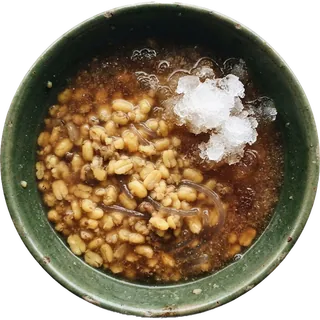
Dry-land taro smoked hard in a stone kiln until it will keep a year, made by Rukai communities in Wutai Township, Pingtung. Eaten as it is, boiled back into porridge with greens, or ground to flour.
How to order
老闆,芋頭乾一包多少?
The dried taro itself is only taro and smoke; the question is what it has been cooked into, so ask 「這個有包豬肉嗎?」 before taking a cinavu parcel or a bowl of taro congee, since both are commonly made with pork.
History
Taro and millet are the two starch crops of the Rukai (Drekay), whose settlements in Wutai Township include Wutai, Jiamu, Dawu, Jilu, Ali, Haocha, Shenshan and Yila. The taro kiln is built of stacked stone on a slope, trapezoidal in plan, with a small low firemouth at the front and a wider, higher chamber behind; the corms sit on a rack above it and are smoked over a slow wood fire for anything from fourteen hours to a day and a night, with people taking turns to watch the heat. The dried corms are then rolled in a spiked bamboo cradle to strip skin and scorch, and laid out on shell-ginger mats. Dried taro is recorded in Rukai as kwai.
What goes into the kiln is taro, wood and smoke, and nothing else; drying is how the crop is kept through the year, doing the work that salting or preserving in fat does in other traditions. Animal ingredients enter afterwards, in the cooking. Dried taro ground to flour is the usual filling for cinavu, where it is packed around pork and wrapped in leaves, and the reconstituted taro is often simmered into a congee with meat. Bought as dried corms, or asked for cooked with wild greens rather than pork, it stays what it is.
Where to get it
Sold in Wutai Township at village shops and at the stalls around the Wutai cultural plaza and the Rukai cultural museum, and by Rukai growers in Majia and Sandimen. The kilns are fired after the taro harvest from November into winter, so dried taro is most plentiful from late in the year.