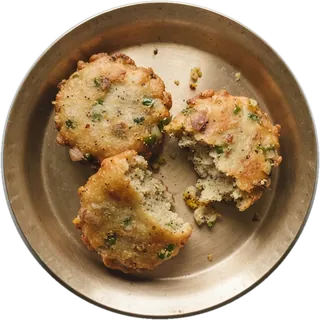
Begun Bhaja
Thick rounds of aubergine, rubbed with turmeric and salt, are shallow-fried in mustard oil until the skin blisters and the edges blacken. It is eaten across West Bengal as a standard opening course alongside rice and dal.
How to order
দাদা, একটা বেগুন ভাজা দিন তো।
It is worth asking the person frying it ‘এটা কি সর্ষের তেলে ভাজা, নাকি ঘিয়ে?’ (is this fried in mustard oil, or in ghee?), since some stalls and kitchens use refined oil or a finish of ghee instead of mustard oil.
History
Begun bhaja is shallow-fried aubergine eaten across West Bengal as part of the structured Bengali meal, where a fried vegetable dish typically opens the courses after rice and dal. Households slice aubergine into thick rounds, rub them with turmeric and salt, and fry them in mustard oil until the skin blisters and the edges char. The same preparation appears in Bengali messes, roadside stalls near markets, and at weddings and shraddha feasts, where it is one of several bhajas served before heavier dishes. It is documented in Bengali home-cooking manuals from the twentieth century as a standard accompaniment to rice.
The standard recipe uses only aubergine, turmeric, salt and mustard oil, so begun bhaja is naturally vegan as cooked in most Bengali households and messes. What a diner still has to watch for is the oil and the pan rather than the vegetable itself: some kitchens finish the slices with a touch of ghee, or use refined oil instead of mustard oil for a milder taste, and stalls frying several items in sequence - fritters, fish fry, aubergine - may use the same pan without separating them. Asking which oil was used is the practical check, since 'bhaja' itself only means fried and covers many dishes, not just this one.
Where to get it
Roadside frying stalls near markets, Bengali mess counters, and home kitchens across West Bengal sell it alongside dal and rice, often fried in the same pan as fish fry and fritters during the midday or evening meal.