Myeongi
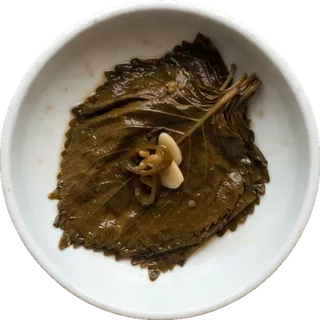
Broad leaves of wild garlic, gathered from Ulleungdo's steep slopes in early spring, are layered in jars and covered with a brine of soy sauce, vinegar and sugar until they turn tender and dark. Islanders eat them wrapped around rice or grilled pork through the lean months before summer crops come in.
How to order
고기 빼고 명이나물만 주세요.
The pickle itself has no meat or fish in it, but at most restaurants it comes as part of a set with grilled pork belly, so ask for the leaves on their own with “고기 빼고 명이나물만 주세요” (skip the meat, just the wild garlic). Many places will bring the jangajji by itself as a side, since it is already plated separately from the meat.
History
Myeongi (명이나물) grows wild on the steep slopes of Ulleungdo, a volcanic island off Gyeongsangbuk-do that the Joseon state kept officially unsettled for centuries before allowing resettlement in the 1880s. The leaf pushes up through late snow in March, before any other crop on the island can be harvested, and islanders still gather it then, layering the leaves in jars with soy sauce, vinegar and sugar until they soften and darken. Restaurants on the island serve the pickled leaves wrapped around grilled pork belly or rice, and the plant's name is said to come from 목숨 명(命), life, for having kept early settlers fed through the hungry end of winter.
None of the usual places animal product hides in Korean cooking apply to myeongi itself: there is no jeotgal paste to season, no anchovy-and-kelp stock to build, no egg to set on top. The brine is soy sauce, vinegar and sugar, boiled and poured over the leaves, and nothing in that process requires meat or fish. The complication is where it is sold rather than how it is made: most Ulleungdo restaurants serve the pickle as a side to grilled pork belly, so ordering the leaves alone, without the meat plate that usually comes with them, is the detail to settle before the table is set.
Where to get it
Harvested each March on Ulleungdo's slopes and pickled for the rest of the year, myeongi-namul is sold in jars near the ferry terminals of Dodong and Jeodong and served as a side dish at island restaurants built around grilled pork belly. A jar runs about 15,000-20,000 won; a side order at a restaurant is closer to 5,000 won.