Porotos Granados
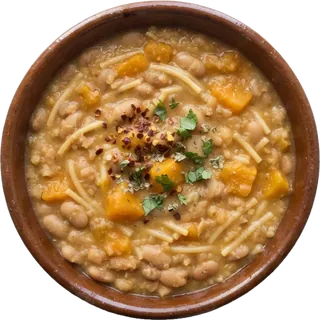
Fresh shelled cranberry beans are stewed with cubed pumpkin, sweetcorn and basil, thickened with grated corn or ladled over sliced mazamorra, in the short weeks of late summer when all three crops ripen together. Family tables across the Maule and O'Higgins valleys serve it as the main course of January and February lunches.
How to order
¿Me da los porotos granados sin tocino, por favor?
Ask whether the pot was started with tocino or caldo de carne before it's ladled out, with “¿Me da los porotos granados sin tocino, por favor?”; market stalls and comedores in the Maule and O'Higgins regions run the counter in Spanish throughout.
History
Porotos granados is named in Spanish for beans left on the plant until the pod swells full; poroto itself comes from the Quechua purutu, and choclo and zapallo carry the same Quechua root, left behind when Inca rule reached south to the Maule River before Spanish conquest. The dish is cooked today across the central valley, in market kitchens in Talca and Rancagua and in Santiago homes, through the few weeks of January and February when beans, corn and pumpkin all ripen together. Spanish colonization dispossessed the Picunche communities who had farmed this same valley for generations before the dish took its present form.
The pot itself is plant start to finish: shelled beans, pumpkin, corn and basil simmered together in water until the broth thickens. Many home cooks render diced bacon or pork fat first and build the sofrito on that, or replace the water with a meat stock, and once either goes in it cannot be lifted back out. Other households, particularly at midday meals built around the vegetables alone, cook the same pot with oil instead of fat and water instead of stock, so the only way to know is to ask the cook, before the beans go into the pot, what the base was built on.
Where to get it
Feria markets and family-run comedores across the Maule and O'Higgins regions, and seasonal menus in Santiago restaurants, served by the plate from January through March; a plate runs CLP 3,000-6,000 at a market stall, more in a Santiago restaurant.