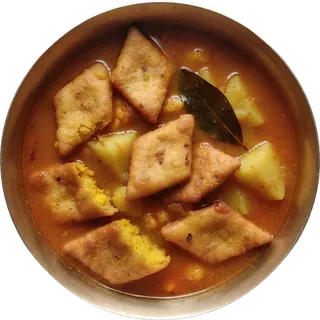
Shukto
Shukto brings together bitter gourd, drumstick, potato and other vegetables in a pale poppy-and-mustard gravy, served as the first course of a Bengali meal to prepare the palate for the richer dishes that follow. The standard Kolkata recipe finishes it with milk and ghee.
How to order
দাদা, দুধ আর ঘি ছাড়া শুক্তো হবে কি?
Ask whether milk or ghee has gone into the shukto before ordering; mustard oil alone is a traditional base, so ‘দুধ আর ঘি ছাড়া শুক্তো হবে কি?’ is a question most Kolkata cooks can answer and often accommodate.
History
Shukto opens a meal in Bengali households across West Bengal and Bangladesh, served just after rice before the dal and fish courses that follow. Kolkata kitchens and messes make it from bitter gourd, drumstick, potato, green banana, brinjal and sweet potato, simmered in a thin paste of poppy seed and mustard. Bengali cookbooks from the late nineteenth century onward record the dish, and it remains a fixture of Durga Puja feasts and daily thalis in Kolkata, where the standard recipe is finished with milk and a spoon of ghee stirred in at the end.
The standard Kolkata version is not plant-based: milk and a finishing spoon of ghee are stirred into the vegetables at the end of cooking, both added after the vegetables are already tender. Some rural and Vaishnava recipes, and versions cooked in mustard-oil-only kitchens, omit the milk and ghee entirely and use mustard oil as the sole fat, relying on poppy seed paste for body instead of dairy. A diner who wants the plant version asks for it to be made without milk or ghee, in mustard oil, which cooks can usually produce since the base recipe does not require dairy to thicken or bind.
Where to get it
Shukto is served at Bengali thalis and household-style messes across Kolkata, and appears on Durga Puja feast menus and in home kitchens through most of the year; some messes and vegetarian thalis already prepare it in mustard oil without dairy.