Chwinamul
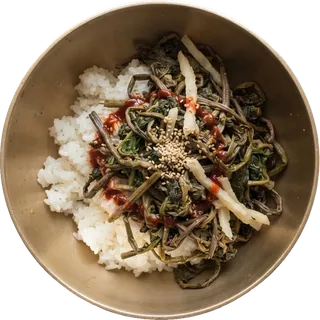
Aster greens gathered each spring on mountain slopes are dried in sheaves and kept through the year, then soaked, boiled and dressed with sesame oil, soy sauce and garlic, or wrapped around rice as a ssam. Gangwon-do's mountain villages eat it daily from dried stock through winter, and fresh each April and May.
How to order
취나물 무칠 때 액젓 빼고 해 주세요.
Chwinamul-muchim is usually just sesame oil, soy sauce and garlic, but some cooks add a dash of aekjeot for depth, so ask before it is dressed: “액젓 빼고 해 주세요.” At set-banchan restaurants the namul often arrives already plated and cannot be remade, so the question only works where it is seasoned fresh per order, as at sanchae-bap counters.
History
Chwinamul (취나물) is the young leaf of the mountain aster, gathered wild on Gangwon-do's slopes each April and May and dried in bundles under the eaves for the rest of the year. Soaked and boiled before cooking, it appears on tables through autumn and winter, and on Jeongwol Daeboreum, the fifteenth day of the first lunar month, households eat a full set of rehydrated dried namul, chwinamul among them, for strength through the year ahead. The habit comes from generations of subsistence farming in Gangwon's mountain villages, where fresh vegetables ran short outside the growing season.
The muchim dressing is sesame oil, soy sauce, garlic, scallion and sesame seed, worked through the boiled leaf by hand — no jeotgal, the salted shrimp or fish paste that seasons kimchi, and no myeolchi-yuksu, the anchovy-and-kelp stock that underlies most Korean soups, enter this dish at any stage, and there is no egg garnish to remove. The one point worth checking is seasoning: some cooks finish the namul with a dash of aekjeot, anchovy fish sauce, in place of or alongside the soy sauce, for a deeper savoury note, so it is this, rather than a hidden stock, that needs settling before the dish is dressed.
Where to get it
Sanchae-bap and sanchae-jeongsik restaurants in Gangwon-do's mountain towns — Pyeongchang, Jeongseon, Taebaek, the hills above Gangneung — serve it as a banchan or wrapped ssam alongside rice, from dried stock through winter and fresh each April and May; a full sanchae-jeongsik set runs 10,000-15,000 won, with chwinamul as one of several small dishes.