Songi-beoseot
Pine mushrooms grow only alongside living red pine and cannot be cultivated, so every one sold is wild, gathered before dawn in autumn while the cap is still closed to keep its scent. Bonghwa and Yangyang hold the country's two best-known harvests, graded and auctioned within hours of picking.
How to order
다른 거 빼고 송이구이만 주세요.
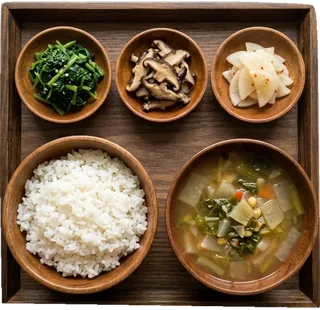
Songi-gui itself — mushroom torn and grilled with only salt and sesame oil — carries no animal product, but it is rarely the only thing on the table: a set meal brings soup and banchan built on myeolchi-yuksu and jeotgal, started well before the order comes in. Ask for the grilled mushroom on its own with “다른 거 빼고 송이구이만 주세요,” and expect that the jeongol or soup served alongside usually cannot be remade without its stock once it's underway.
History
Songi-beoseot (송이버섯) grows only under living red pine, trading sugars with the tree's roots in a bond no greenhouse has reproduced, so every mushroom sold is wild, never farmed. The harvest runs about three weeks each autumn, from early September into October, concentrated in Bonghwa county in Gyeongsangbuk-do and Yangyang county on Gangwon's coast, where pickers hold cutting rights to named hillsides and rise before dawn to pick the caps while still closed. Korea has exported songi to Japan since the colonial period, and that Japanese demand still sets much of the price a Korean kitchen pays today.
Grilled songi has no hidden animal product to find: the whole preparation is mushroom, salt and sesame oil, torn by hand at the table and dipped rather than cooked into anything else. The question is what comes with it. A restaurant plate of songi rarely stands alone — it arrives inside a course of banchan and often beside songi-jeongol or a beef broth, and those dishes are where myeolchi-yuksu stock, jeotgal in the kimchi, or a raw egg yolk can enter. None of that touches the mushroom itself, but it has to be sorted out dish by dish before the rest of the table is served.
Where to get it
Roadside auction markets in Bonghwa and songi-specialty restaurants in Yangyang sell it fresh for about three weeks each September and October. A small grilled portion at a restaurant runs ₩50,000-100,000, and raw mushrooms at the Bonghwa auction trade by weight at ₩100,000-300,000 per kilogram depending on grade.