Jatjuk
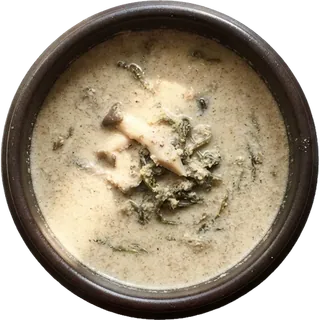
Rice is soaked, ground fine with pine nuts and water, then simmered slowly, stirred without pause, until it thickens into a pale, oil-rich porridge. It is the most expensive bowl on a juk shop's menu, ordered for the convalescent, the elderly and new mothers across Seoul.
How to order
잣죽 하나 주세요.
Nothing needs to be asked here — the pot holds only pine nuts, rice, water and salt, with no stock, jeotgal or egg to request out, so "잣죽 하나 주세요" orders it exactly as it is made.
History
Jatjuk (잣죽) is made by soaking rice, grinding it with pine nuts and water on a stone mill, then cooking the mixture slowly over low heat, stirring the whole time so it does not catch or separate. Pine nuts have long come from the pine forests of Gangwon-do, where growers around Hongcheon and Chuncheon gather the cones each autumn, and the dish itself was once a yangban and court food, too costly and too labor-heavy for ordinary households. It survives today as a sickroom and postpartum dish, and in Seoul it sits, priced well above rice or bean porridges, at the top of every juk shop's menu.
The three usual places animal product enters Korean cooking do not apply to jatjuk. There is no kimchi paste here to carry jeotgal, no myeolchi-yuksu beneath it the way there is under a bowl of guksu, and no egg is cracked over the top as a garnish. The porridge is pine nuts, soaked rice, water and salt, ground and simmered together, nothing added at the table and nothing hidden in the pot. Ordering it the way it is usually made already means ordering it plant-based, and no question needs to be put to the kitchen before it arrives.
Where to get it
Juk specialty chains and small juk jip around Seoul, including branches near hospitals and clinics, keep jatjuk on the menu for patients and visiting family, priced around 11,000-14,000 won a bowl; in Gangwon-do's Hongcheon, autumn markets sell the raw pine nuts the dish depends on.