Gondre
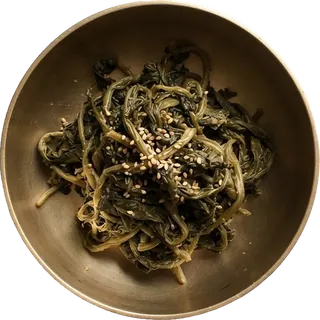
Dried thistle greens, rehydrated and stirred into rice as it steams, turn the grain dark green and faintly bitter; a small bowl of soy-sesame sauce comes alongside to mix through at the table. It is a specialty of Jeongseon county in the Gangwon mountains, eaten there at lunch counters year-round.
How to order
곤드레밥 버터 빼고 주세요.
Butter is stirred into the rice at the stove just before it is dished up, so ask when you order: “곤드레밥 버터 빼고 주세요.” Most gondre-bap kitchens cook each bowl to order and can leave it out if asked at that point, since it goes in at the very end rather than from the start.
History
Gondre (곤드레) is the common name for a wild thistle, Cirsium setidens, that grows on the slopes of the Taebaek range in Gangwon province. Through the autumn the leaves are picked, blanched and dried on strings under eaves, stored to get a household through winter when fresh vegetables ran short. In the hunger that followed the Korean War, families in Jeongseon and Pyeongchang stretched their rice by cooking it in with dried gondre, bulking the grain out with a free mountain weed. The dish has since moved from scarcity food to a specialty worth a drive into the mountains for.
The base recipe is plant-only: dried gondre, rice, sesame oil and soy sauce, with the dipping sauce made from soy, sesame oil and scallion. None of the usual hiding places apply — there is no kimchi paste here to carry jeotgal, and the dish is a rice, not a soup, so no anchovy-kelp stock underlies it, and no egg appears as a garnish. The detail that does matter is butter: many lunch counters around Jeongseon finish the rice with a pat of butter stirred in just before serving, melted into the grain at the stove rather than added at the table.
Where to get it
Lunch counters and gondre-bap specialist restaurants around Jeongseon, in the Gangwon mountains, open year-round but busiest from spring through autumn when hikers pass through; a bowl runs 8,000-12,000 won.