Couve Mineira Refogada
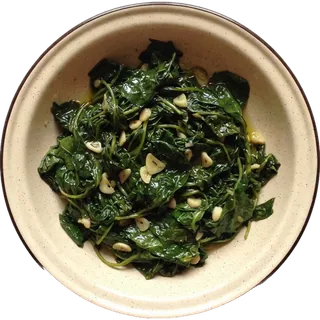
Collard greens rolled tight into a cylinder, sliced crosswise into ribbons thinner than a toothpick, and dropped into a hot pan with garlic and oil for less than a minute. Served warm beside rice and beans at lunch in Belo Horizonte and across Minas Gerais, in homes, botecos and self-serve restaurants charged by weight.
How to order
Essa couve tem toucinho, ou pode ser só no alho e óleo, por favor?
The transaction runs in Portuguese. Ask whether the couve was started “só no alho e óleo” or whether toucinho went into the pan first; at a self-serve counter the answer is often fixed because the pan was cooked hours earlier, so the only real option is asking the kitchen to start a separate batch “sem toucinho”. At a home table or a boteco taking orders to the kitchen, the same request can still change what lands on the plate.
History
Couve mineira is Portuguese for Minas-style collard greens, and the name describes a cut as much as a dish: the leaves are stacked, rolled into a tight cigar, and sliced crosswise into ribbons so fine they fall apart in the pan, a technique called couve à mineira. The greens grow in market gardens around Belo Horizonte and in towns across the interior of Minas Gerais, sold by the bunch at feiras and corner greengrocers. Home cooks and the cooks at self-serve restaurants charged by weight (a quilo) wash and roll the leaves, then throw them into a hot pan with garlic and oil for under a minute, just long enough to wilt without turning them dark. It is set out at lunch beside rice and beans, rarely eaten alone.
The greens themselves are entirely plant: leaves, garlic, oil or lard, and salt, wilted fast over high heat. Animal product enters earlier, in many kitchens, when a few cubes of bacon or toucinho are rendered in the same pan before the couve goes in, so the fat the greens cook in already carries pork. That rendering happens during cooking, not at the table, so once the leaves have hit the pan there is nothing left to ask for. What has to be settled is upstream: whether the pan was started with toucinho at all, and if so, whether a separate batch can be made with oil alone. At self-serve restaurants the couve on the steam table was decided before the doors opened; at a home table or a boteco taking orders, it can still be changed.
Where to get it
Lunch counters, self-serve restaurants charged by weight (a quilo), botecos and home kitchens across Belo Horizonte and interior towns of Minas Gerais, served year-round as a side with rice and beans, for roughly R$3-8 as part of a per-kilo plate or included in a fixed lunch price of R$20-35.