Oi-sobagi
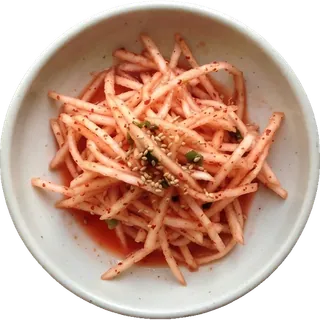
Cucumbers are slit into quarters along their length, left joined at one end, then packed with a paste of chive, garlic, ginger and chilli powder. Seoul and Gyeonggi households make it in July and August, when cabbage kimchi turns soft in the heat and a faster, fresher kimchi is needed within days.
How to order
오이소박이 젓갈 빼고 주세요.
Restaurant oi-sobagi is usually stuffed in one large batch for the week's banchan, so the jeotgal is already mixed into the paste before the first plate goes out; ask with “오이소박이 젓갈 빼고 주세요”, and expect it can only be honored if the kitchen still has unstuffed cucumbers on hand or a market stall that packs them to order.
History
Oi-sobagi (오이소박이) is a summer kimchi made across Seoul and the Gyeonggi region, where cucumbers are plentiful and ripen fast in the heat. A cook slits each cucumber lengthwise into three or four sections, stopping short of the base so the quarters fan open but hold together, then packs the cuts with a mixture of chives, garlic, ginger and gochugaru. It is made in small batches through July and August, eaten within two or three days rather than fermented for months, and served as a side at ordinary family meals rather than at holiday tables like Chuseok or Seollal.
The cucumber, chive, garlic and chilli powder are plant throughout, but most households and nearly all restaurant kitchens add a few spoonfuls of saeujeot or anchovy fish sauce to the stuffing paste, a standard seasoning in Korean kimchi rather than an optional extra. It goes in during preparation, mixed into the paste before it is packed into the cucumbers, so it cannot be removed afterward. Myeolchi-yuksu stock and egg do not apply here, since the dish is not simmered and carries no garnish; the paste itself is the only point where animal product enters, and that has to be settled before the cucumbers are stuffed.
Where to get it
Banchan shops and traditional markets across Seoul and Gyeonggi-do, including Gwangjang Market, sell it by the container through July and August; a small tub runs 3,000-5,000 won, and most households make their own rather than buying it.