Shansu
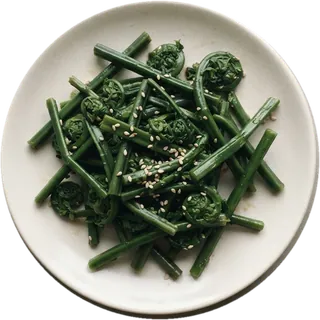
Shansu is the curled young frond of the bird's-nest fern, blanched and then stir-fried hard with garlic, ginger, chilli and pickled cordia berries. It is grown under shade in Guangfu Township and eaten across Hualien.
How to order
老闆,炒山蘇不要加小魚乾,謝謝。
The dried anchovy is fried in the oil at the start rather than scattered on top, so it has to be left out before cooking; say 「炒山蘇不要加小魚乾」 and check the dish is not finished with fried shallot crisps or stock.
History
The bird's-nest fern grows on tree trunks and rock faces in lowland forest, and its tender curled shoot, called lokot in Amis, was gathered and cooked long before anyone farmed it. From 1993 growers in Hualien began bringing plants down from the hills and planting them under betel palms and shade netting, with the Hualien District Agricultural Research and Extension Station developing spore and tissue-culture propagation so that stock no longer had to be dug from the forest. Guangfu Township became one of the main growing areas, with about twelve hectares recorded in the late 1990s and three production and marketing groups listed later. The shoot is snapped by hand to find where the stem turns woody.
The vegetable is plant-based, but the standard restaurant plate is not. Shansu is almost always fried with small dried fish, usually anchovy, which is crisped in the oil first to season the whole dish; some versions also use chicken stock or fried shallot crisps. The flavour those fish supply is salt and depth, and fermented black beans, pickled cordia berries and dried shiitake do the same work. Kitchens are used to the request and several published recipes mark the dried fish as the part a vegetarian leaves out, so it is a normal thing to ask at the counter.
Where to get it
Guangfu's First Market sells the fresh shoots alongside other wild vegetables in the morning, and Amis restaurants in the township cook it to order, among them Hong Wa Wu Laodifang (紅瓦屋老地方) in Guangfu; it also reaches markets and restaurants across Hualien year-round.