Bhatt ki Churkani
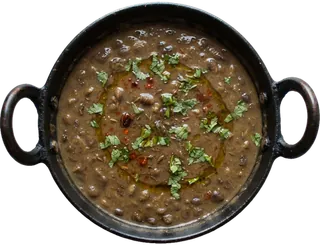
Black soybeans (bhatt) are dry-roasted, ground to a coarse paste, and simmered into a thick dark gravy finished with mustard oil, a dish documented in Kumaoni households around Almora as a winter staple.
How to order
भैया, एक प्लेट भट्ट की चुरकानी दीजिए।
To confirm the plate is plant-only, ask ‘क्या इसमें घी डाला है?’ and request that any curd or buttermilk accompaniment be served apart from the main dish.
History
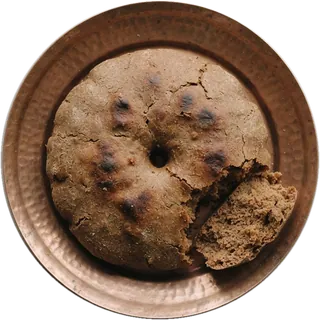
Bhatt ki churkani is made in Kumaoni households around Almora, in the hill district of Uttarakhand, where black soybean (bhatt) has long been grown on terraced, rain-fed fields. The beans are dry-roasted until dark and fragrant, then ground to a coarse paste on a stone slab or in a mill. Cooks loosen the paste with water and simmer it slowly, sometimes for over an hour, into a thick, dark gravy finished with mustard oil, garlic, ginger, and red chili. It is served with rice or with jaulee, a flatbread of mixed wheat and rice flour, and is recorded as a regular winter dish of the Almora region through the twentieth century.
The standard recipe for bhatt ki churkani contains no animal ingredient: the base is roasted black soybean, water, mustard oil, and spices such as garlic, ginger, turmeric, and dried red chili. In home kitchens a spoon of ghee is sometimes stirred in just before serving, and the dish is commonly plated beside dahi (curd) or buttermilk as a side, so a diner checking for a plant-only meal should ask whether ghee has been added and request the curd be left off the plate. In dhabas and hill tourist kitchens the same pan may also be used to finish dishes containing ghee or meat, so cross-contact is worth asking about where kitchens are small and equipment shared.
Where to get it
Bhatt ki churkani is cooked at home through the Kumaon winter and served in small Kumaoni-cuisine eateries and tourist lodges in and around Almora; it also appears on festival and wedding menus alongside other bhatt and gahat preparations.