Bolinho de Estudante
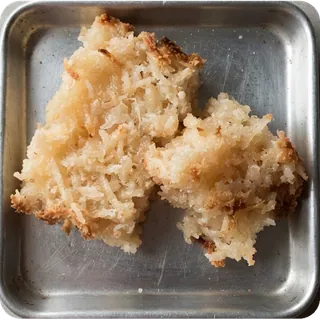
Granulated tapioca and grated coconut bound with sugar, shaped into small balls, deep-fried, then rolled in sugar and cinnamon while hot. Sold by street vendors in Salvador, scooped into paper cones for eating on foot. Each ball measures about 6 centimetres across, eaten in two or three bites.
How to order
Os bolinhos de hoje levam ovo ou leite condensado? Se não levar, me vê uns quatro, por favor.
The sale runs in Portuguese. Asking “leva ovo ou leite condensado?” before pointing at the cone covers it, since the dough is mixed and fried well before the stall opens, and nothing can be adjusted once the balls are in front of the customer. If the vendor answers “não leva”, that batch is plant-only from tapioca to coating; if egg or condensed milk went into the mix, that particular tray stays as it is.
History
Bolinho de estudante is Portuguese for "student's little cake," a name street vendors in Salvador, Bahia, use without a settled origin story — some tie it to university students buying cheap snacks near the Terreiro de Jesus and Praça da Sé, others to its sale outside schools. Vendors mix granulated tapioca (tapioca granulada) with grated coconut and sugar, work the mass into balls the size of a golf ball, deep-fry them in oil until the surface sets, then roll them hot in a mix of sugar and cinnamon. Carts and stalls in the Pelourinho and around Barra sell them year-round, scooped into paper cones alongside other fried sweets.
The base of granulated tapioca, grated coconut, sugar and frying oil is plant throughout, with the sugar-cinnamon coating added after frying, also plant. A portion of cooks bind the raw mass with a beaten egg or a spoonful of condensed milk to hold the balls together before they go into the oil, and this happens at the mixing stage, hours before any customer arrives. What has to be settled is therefore not at the fryer but with the vendor directly, asking what the batch was bound with before it goes into the oil; once a tray of bolinhos is fried, the question cannot be undone, so the only working approach is to ask before buying rather than after.
Where to get it
Street carts and stalls across Salvador — the Pelourinho, Praça da Sé, and the beachfront at Barra — sell them year-round, by the cone at roughly R$5 to R$8.