Cocada Baiana
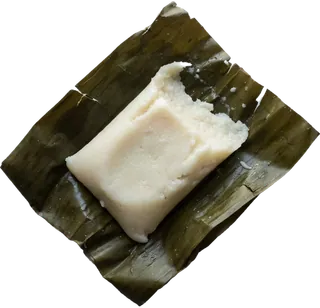
Grated coconut cooked down with sugar and water until the mass sets firm, then cut into squares — pale if made with white sugar, dark if molasses or burnt sugar goes in. Vendors carry it on trays along beaches and street corners in Salvador and across Sergipe, selling a square at a time.
How to order
Me vê uma cocada branca, sem leite condensado, por favor.
The transaction runs in Portuguese, whether on the sand in Salvador or at a corner stall in Aracaju. Asking for cocada “sem leite condensado” settles it, since the condensed-milk version is a separate batch cooked that way from the start, not something added at the counter — if the tray in front of you is already the creamy kind, no request changes it, and you ask which tray is which instead.
History
Cocada is Portuguese, built on coco, coconut. The sweet is associated above all with Salvador da Bahia and the towns of Sergipe, where cocadeiras — vendors, often women, working from home kitchens — grate fresh coconut by hand or machine and cook it in a copper or aluminum pan with sugar and water until the mixture pulls away from the pan sides and sets as it cools. The white version uses refined sugar; the dark, called cocada preta or cocada queimada, is cooked with burnt sugar or rapadura. Trays go out onto the sand at Barra and Rio Vermelho in Salvador, and onto street corners and bus stops in Aracaju, through the morning and into the evening.
The base is entirely plant: coconut, sugar, water, sometimes a stick of cinnamon or a clove cooked in and lifted out. No animal product is needed to set it — the sugar itself does that as it cooks down. Some cocadeiras, though, make a softer, creamier version with condensed milk stirred into the pan, which changes both the texture and the colour toward ivory. Since the condensed milk goes in during cooking, not after, what has to be settled is which pan the square came from — plain coconut-and-sugar, or the one with condensed milk already in it — before buying, not after.
Where to get it
Beach vendors in Salvador (Barra, Rio Vermelho, Porto da Barra) and street-corner and market sellers across Sergipe, especially Aracaju, carry it year-round with heavier trade through the summer beach months; a square runs about R$2 to R$5.