Boribap
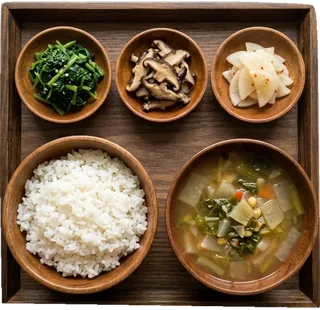
Barley is boiled until it splits, then steamed with white rice in a ratio that shifts with season and memory of leaner years. It is served with a tray of namul and a pot of doenjang stew, mixed together at the table in the farm towns of Gyeongsangbuk-do and the old market districts of Busan.
How to order
찌개는 멸치 육수 빼고 끓여 주세요.
Doenjang stew is usually made in one shared pot for the whole kitchen, anchovy or beef already simmered into the stock before the lunch rush starts, so asking after the bowl arrives is too late. At the counter say “찌개는 멸치 육수 빼고 끓여 주세요,” though many small places cook only one pot of stew a day and may not be able to start a separate batch; a plate of barley rice and namul without the stew is the fallback.
History
Boribap (보리밥) began as a substitute, not a choice: in Gyeongsangbuk-do's dry-field villages, where paddy rice ran short before the autumn harvest, barley carried households through the hungry months of early summer, a hardship sharpened by Japanese colonial grain requisitions and by the famine years after the Korean War. Farm households boiled hulled barley twice, once to soften the husk and again with a portion of white rice, then set it beside whatever namul the season gave: wild greens in spring, dried vegetables in winter. In Busan's postwar markets, boribap stalls fed dockworkers and refugees, and the dish remained a fixture of market-district lunch counters long after rice became plentiful.
The bowl itself is plant throughout: barley, white rice, namul and the gochujang mixed in at the table carry no animal product. The doenjang stew served alongside is the open question — most kitchens simmer it on myeolchi-yuksu, dried anchovy and kelp stock, and some use beef instead, built into the broth before it ever reaches the table. Once that stock is made, the anchovy or beef cannot be removed afterward, so it has to be settled at the point of ordering; a stew made on kelp and dried mushroom alone, with no meat or fish stock, is what to ask for.
Where to get it
Farm-town diners in Gyeongsangbuk-do and boribap specialists in Busan's older market districts serve it at lunch, usually as a fixed-price set with the tray of namul; a bowl with stew runs 8,000-12,000 won.