Dongchimi
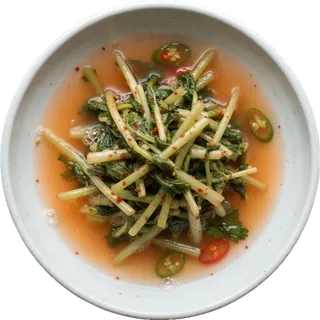
Whole small radishes are packed into salted water with pear, ginger and garlic, then left to ferment through the winter until the brine turns tart and faintly fizzy. Gyeonggi and Chungcheong households drink the liquid on its own or pour it, chilled, over buckwheat noodles at the winter solstice.
How to order
젓갈 안 넣은 동치미로 주세요.
Jeotgal, when a recipe calls for it, is stirred into the brine weeks before the radish is ready, so it cannot be fished out of a finished jar. Ask before ordering or buying with “젓갈 안 넣은 동치미로 주세요,” since many households and restaurants keep only one batch fermenting at a time and may have no jeotgal-free jar on hand that day.
History
Dongchimi (동치미) is a water kimchi made by fermenting whole small radishes in lightly salted water with pear, ginger and garlic. Households across the central provinces, Gyeonggi-do and Chungcheong, pack the radishes into large earthenware onggi each winter alongside the kimjang batches of cabbage kimchi, then leave the jars in a cold shed or buried in the yard for several weeks. The finished brine, tart and faintly carbonated, is drunk on its own, ladled over rice, or used as the cold broth for mul-naengmyeon, and it is part of the food set out at the winter solstice, dongji.
The base recipe is plant throughout: radish, water, salt, pear, ginger and garlic, with no stock required since the dish is built on fermentation rather than a cooked broth. Jeotgal (salted fermented seafood), the ingredient that most often carries animal product into Korean kimchi paste, goes into dongchimi only in some household and restaurant recipes, stirred into the brine with the garlic and ginger before fermentation begins. Once that happens it cannot be separated out afterward, so a plant-based batch depends on the recipe used from the start, which is the detail worth asking about before the jar is opened, not at the table.
Where to get it
Home kitchens, banchan counters and naengmyeon restaurants across Gyeonggi-do and Chungcheongbuk-do serve it free alongside noodles or rice from roughly November through February; jars of it also turn up at traditional markets, priced around ₩5,000-8,000.