Güllük
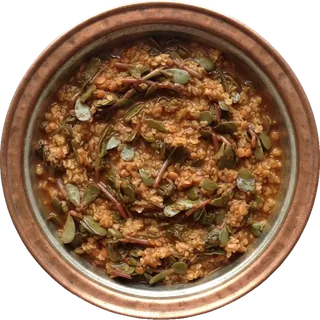
Güllük is a dish of wild beet greens from the uplands around Muş, picked in spring and simmered down with rice and onion until they collapse into a soft, dark green stew with grains of rice suspended in it.
How to order
Güllük var mı acaba?
Ask before it is cooked whether the egg and butter can be left out, saying “yumurtasız ve tereyağsız olur mu?” (could it be without egg and without butter?), since both are already mixed into the pot by the time it reaches the table.
History
Güllük comes from the Muş plain and the hills around it, in the far east of Turkey, where Kurdish-speaking villagers gather wild beet greens as soon as they push up after the snow melts in March and April. The greens are called güllük in Kurmanji and sold in local markets as yabani pancar, wild beet, in Turkish. Home cooks wash the leaves and stalks, boil them once to soften their bitterness, drain them, and return them to the pot with onion softened in fat, rice, and water, letting everything simmer together until the rice is cooked through and the greens have broken down into the grain.
Everything up to that point is plant: the greens, the onion, the rice, the water. The animal product enters twice, both in the kitchen rather than at the table. An egg is beaten in during the last few minutes of cooking and folded through off the heat so it sets into soft curds through the greens, and butter is used as the fat the onion is softened in and sometimes added again at the end to finish the pot. Because both are already cooked into the dish by the time it is served, there is nothing left to ask for or refuse at the table; the only moment either can be left out is before the pot is covered, when the cook is asked directly not to add them.
Where to get it
Home kitchens and small lokantas in and around Muş make it in spring, from March to May, while the wild beet shoots are still young and tender.