Uşkun
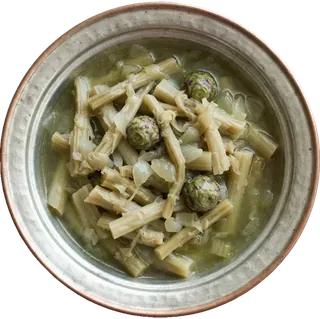
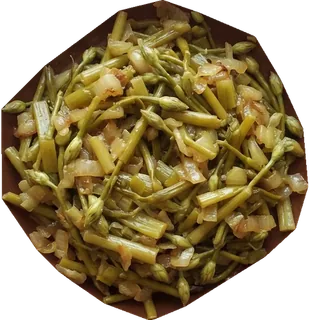
Uşkun is the young stalk of wild rhubarb, Rheum ribes, pulled from the rocky slopes of Hakkâri as the snow melts in April and May. The stalk is peeled to its pale core, pink to pale green, and eaten raw with salt or simmered down into a sour side dish.
How to order
Uşkun yoğurtsuz olsun lütfen.
Asking for it “yoğurtsuz” — without yogurt — gets the stalks served plain, in their own sour liquid, with nothing spooned over at the table.
History
Uşkun grows wild on the high slopes around Hakkâri in southeastern Turkey, pushing up through melting snow in April and May. Families from the surrounding villages climb to gather it before the stalks toughen and turn fibrous. In Kurmanji it is called uşkun or işkîn; in Turkish it is known as ışkın or dağ ravendi, mountain rhubarb. The stalks are cut at the base, carried down in bundles, and peeled by hand to remove the tough outer skin. What remains is eaten raw, dipped in salt, or chopped and simmered with onion and a little water until it collapses into a sour, pulpy side dish served alongside the main meal.
The stalk itself, raw or simmered, is plant only: rhubarb, water, salt, sometimes onion. The question sits with the cooked version, which many households finish with a spoonful of yogurt stirred in at the table, cutting the sourness with something milky. That step happens after the pot is off the heat, not during the cooking, so it can be asked about and left out. A plate ordered plain, with the yogurt kept separate or omitted, is the plant-based version; one already stirred together cannot be taken apart afterward.
Where to get it
Uşkun turns up in village markets and roadside stalls around Hakkâri and Yüksekova from April through early June, while snow is still retreating on the higher slopes. It travels poorly and is rarely found outside the province.