Kereng
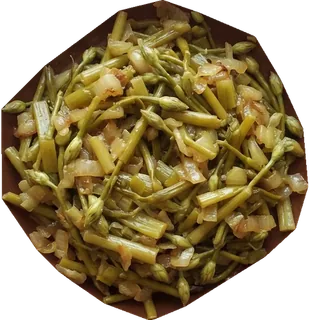
Kereng is the trimmed, stewed stalk and flower head of Gundelia tournefortii, a spiny wild thistle gathered in the mountains of Hakkari each spring. Stripped of its thorns down to a pale fibrous core, it is simmered until tender and faintly bitter.
How to order
Kerengi tereyağsız yapar mısınız lütfen?
Ask for it cooked “tereyağsız” (without butter) before the pot comes off the heat, since butter is usually worked in during cooking, not after. When the bowl arrives, decline the yogurt spoon offered at the table.
History
Gundelia tournefortii grows wild on the rocky slopes of Hakkari province in southeastern Turkey, pushing up in March and April before its bracts harden into full spines. Kurdish households around Hakkari, Çukurca and Şemdinli call it kereng; the same plant is kenger further west, in Gaziantep and Şanlıurfa, and akkoub across the border in Arabic. Foragers cut the young stalks and unopened flower heads, then pare away the spikes with a knife, leaving only the tender core. The trimmed stalks are boiled or stewed slowly, sometimes with onion, until the sharp bitterness settles into something closer to an artichoke heart.
The plant itself, once trimmed, is nothing but vegetable matter, water and salt. Animal product enters at two separate points. Butter is often melted into the pot while the stalks cook, the standard finishing fat for a stewed vegetable in this region, so by the time the dish reaches the table it may already not be plant-based. A spoon of yogurt is added afterward, at the table, and that part is easy to refuse. Only asking before the pot is finished settles the butter; the yogurt can simply be waved off once the bowl arrives.
Where to get it
Found in home kitchens and small lokantas around Hakkari city and villages like Çukurca and Şemdinli, mainly in March and April when the young stalks are still soft enough to trim.