Po'e
Ripe banana or pumpkin is mashed with flour and baked slowly in the umu, the stone-lined earth oven, until it sets dense and caramelises on top. It appears at family gatherings and curanto feasts across Hanga Roa, Rapa Nui's only town.
How to order
¿Me da un po'e, por favor?
Ask whether egg, butter or condensed milk went into the mix before baking, since nothing can be removed once the po'e comes out of the umu: “¿Tiene po'e sin huevo ni mantequilla?” Bakeries and the market stalls in Hanga Roa run the counter in Chilean Spanish, with Rapa Nui spoken at home and among family cooks.
History
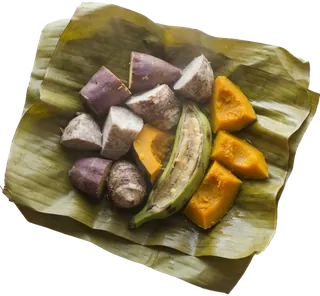
Po'e takes its name from Rapa Nui, the Polynesian language of Easter Island, and is baked across Hanga Roa, the island's only town, where most of the Rapa Nui population has lived since Chile annexed the island in 1888 and confined islanders to company-controlled land for decades. Ripe banana or pumpkin is mashed with flour, wrapped in banana leaf, and lowered into the umu, the stone-lined earth oven also used for curanto, to bake slowly until the top blackens and caramelises. It is served at family meals, at Tapati Rapa Nui in February, and at curanto gatherings where the umu is already lit.
The base is plant: mashed banana or pumpkin bound with flour and water, sweetened lightly, then baked until it sets into a dense, sticky block. Many households still cook it this way. Modern versions, especially those served to visitors or sold at bakeries in Hanga Roa, mix in egg, butter or condensed milk before the dish goes into the oven, which means the batter is already fixed by the time it reaches the table. Once baked, it cannot be separated out, so the plant-only version has to be requested, or confirmed, before the pan is loaded into the umu.
Where to get it
Bakeries, home cooks and the Sunday market in Hanga Roa, Rapa Nui's only town, sold by the slice or whole pan, often tied to curanto gatherings and the Tapati Rapa Nui festival in February; a slice runs CLP 1,500-2,500 at a bakery counter.