Pyogo-beoseot
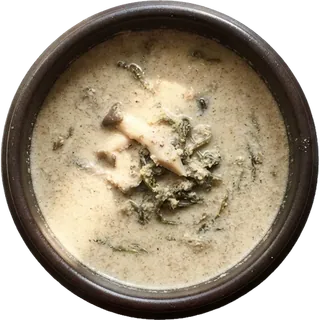
Shiitake caps are grown on oak logs stood upright in forest shade, picked, and sun-dried until the gills darken and the flesh concentrates. Temple kitchens in Jeollabuk-do and Gangwon-do soak the dried caps overnight and keep the soaking water as a stock base, used in place of dried anchovy.
How to order
멸치 육수 말고 표고버섯 육수로 해 주실 수 있어요?
Restaurant stock is usually made and portioned before the first order of the day, mixing shiitake with dried anchovy and kelp, so asking a kitchen to strip the anchovy out after the pot is already started is usually not possible; the question has to be raised while the day's stock is still being decided, with “멸치 육수 말고 표고버섯 육수로 해 주실 수 있어요?” Temple restaurants and some vegetarian kitchens keep a separate shiitake-only stock made in advance for exactly this reason.
History
Pyogo-beoseot (표고버섯) is cultivated on cut oak logs, called wonmok, stood in rows under forest canopy in Jangsu county, Jeollabuk-do, and in the mountain valleys of Gangwon-do, where spores are driven into drilled holes and the logs left two winters before the first flush appears. Pickers cut the caps by hand through spring and autumn, and growers string or tray-dry them in the sun until they shrink hard and keep for a year. Dried shiitake travel from mountain farms to temple kitchens and city markets alike, where they are soaked before every use, the soaking water kept rather than thrown out.
A mushroom, pyogo-beoseot carries no animal product in itself, dried or fresh, and growing or drying it never calls for jeotgal, stock or egg. The only question is how it is used after purchase: temple cooks substitute the dark soaking water for myeolchi-yuksu, the anchovy-and-kelp stock that underlies most secular broths, but a home or restaurant kitchen may use dried shiitake only to deepen an anchovy stock rather than to replace it. Buying the dried mushroom settles nothing by itself; the stock it goes into is the part to ask about.
Where to get it
Dried shiitake is sold by the bag at traditional markets such as Namdaemun in Seoul or the agricultural cooperative stalls in Jangsu, Jeollabuk-do, year-round, a 300g bag running ₩8,000-15,000 depending on grade; the prepared dish, shiitake-stock noodles or namul, is served at temple-food restaurants near mountain temples in Jeollabuk-do and Gangwon-do, a bowl running ₩9,000-13,000 at lunch.