Thepe
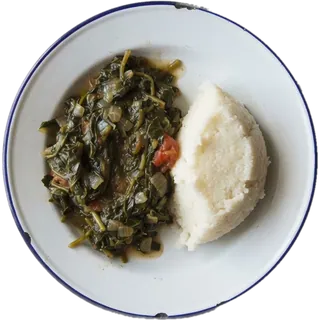
Young amaranth leaves, pulled from between the maize rows in summer, are boiled soft with onion and salt, sometimes finished with peanut butter. Limpopo households serve it beside pap, the plate by which other wild greens, or morogo, are measured.
How to order
Ke kgopela thepe, hle.
Thepe itself is already plant-based, made from greens, onion, salt, oil and sometimes peanut butter; the one thing worth asking is whether it is served on the same plate as a meat stew, which can be waved off with ‘Ka ntle le nama, hle’ — without meat, please. Stalls and home cooks in Limpopo run this conversation in Sepedi as often as in English.
History
Thepe is the Sepedi name for amaranth, gathered wild from between rows of maize across Limpopo — around Sekhukhune, Polokwane and the Bolobedu lowveld — through the summer rains from December into February, when the leaves are young. Setswana speakers use the same word; isiZulu speakers call it imbuya. Women and children pick it while weeding the maize, and it is cooked daily as the relish eaten with pap. Under apartheid, Sepedi speakers were confined to small plots in the former Lebowa bantustan, where wild greens such as thepe supplemented maize meal on land too limited to feed a household alone.
The pot holds amaranth leaves, onion, salt and oil, all plant; many cooks finish it with a spoonful of peanut butter, stirred in at the end to soften the bitterness and thicken the sauce, itself a plant ingredient. No stock, fat or dairy enters at any point in the usual household version, so nothing needs to be settled before eating. Where thepe is served alongside a meat stew as part of a full plate, it is the meat dish that is separate, not the greens themselves.
Where to get it
Home kitchens and township eateries across Limpopo, especially around Polokwane, Tzaneen and Sekhukhune, serve it at lunch and supper beside pap. In summer, once the rains bring the greens up between the maize, roadside stalls sell it by the scoop for about R10 to R15.