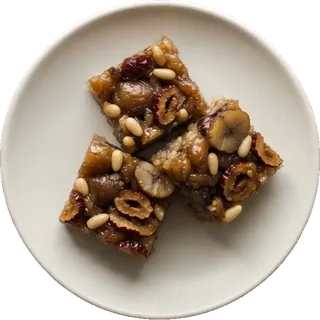
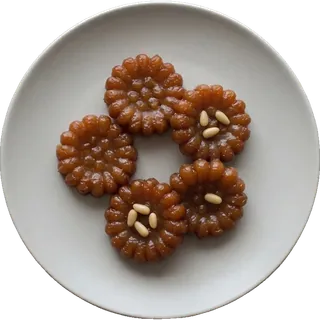
Gangjeong
Puffed rice, sesame seeds or nuts are bound with hot grain syrup, pressed flat into a tray and cut into bars while still warm, the syrup setting as it cools. Families press trays of it before Seollal, the lunar new year, and markets sell it by weight year-round in Seoul and Gyeongsangbuk-do.
How to order
꿀 말고 조청 들어간 걸로 주세요.
Honey and jocheong are both cooked into the puffed grain before it goes into the tray, so neither can be picked out of a finished bar; ask before buying with “꿀 말고 조청 들어간 걸로 주세요.” Market stalls selling loose gangjeong by weight often keep both versions side by side without a label, so it is worth asking rather than guessing from the color.
History
Gangjeong (강정) belongs to hangwa, the category of traditional Korean confections built from grain, nuts and syrup rather than flour and butter. Puffed rice or millet is folded hot into jocheong, syrup cooked down from malted barley, pressed into a wooden tray lined with sesame seeds or crushed pine nuts, then cut into bars before it hardens. Households across Gyeongsangbuk-do and the rest of the country make trays of it in the week before Seollal, the lunar new year, setting it on the charye table for ancestral rites and sending it as a gift; Gyeongju's hangwa shops, tracing their trade to the Silla court, sell it by the box.
The base is plant throughout: puffed grain, nuts or sesame, and jocheong, a syrup made by fermenting cooked rice with malt and reducing it down, with no jeotgal, fish stock or egg anywhere in the recipe. The one point to check is the binding syrup itself: some households and shops swap in kkul, honey, in place of jocheong, either for flavour or because it sets faster, and the syrup is cooked into the puffed grain before pressing, so it cannot be scraped off a finished bar. Whether a tray was made with honey or with jocheong has to be settled before it is cut and sold, not after.
Where to get it
Traditional markets such as Gwangjang Market in Seoul sell gangjeong loose by weight year-round, and hangwa shops around Gyeongju in Gyeongsangbuk-do sell it boxed as a Seollal gift; loose gangjeong runs about 3,000-6,000 won per 100 grams, and a gift box 15,000-25,000 won.