Marua Roti
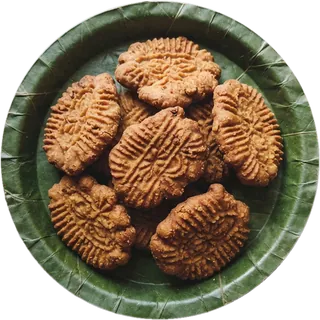
Marua roti is a thick, dense flatbread made from finger millet flour grown across the Khunti plateau in Jharkhand, scalded with hot water and patted by hand before cooking on a hot surface. It carries an earthy, nutty taste and forms the everyday bread of Munda and Oraon Adivasi households in the region.
How to order
एक प्लेट मड़ुआ रोटी दीजिए।
Marua roti itself is plain millet bread, but households sometimes serve it with dal or vegetables finished in ghee, so it is worth asking ‘इसमें घी डाला है क्या?’ when buying it at a stall.
History
Finger millet, known locally as marua, grows on the uplands and forest edges of Khunti district in Jharkhand, where Munda and Oraon Adivasi households have cultivated it as a staple alongside rice and maize. The grain is dried, husked and ground into flour at local mills or by hand on stone querns. To make marua roti, the flour is scalded with boiling water, kneaded while still warm, and shaped into thick discs by hand, since the dough is too dense to roll with a pin. It is cooked on a hot iron plate until firm, then eaten with vegetables, dal, or a chutney of tomato or mustard, often for the midday meal taken to the fields.
Marua roti is naturally vegan: the standard recipe uses only finger millet flour, water and salt, with no dairy, ghee or any other animal ingredient at any stage of preparation. Unlike wheat or rice flour doughs elsewhere in India, this one is not enriched with milk or curd, and it is not finished with a pour of ghee before serving, since ghee is reserved in most Khunti households for festival cooking or for the rice served alongside. A diner eating marua roti at a village market stall or in an Adivasi household kitchen can expect the bread itself to contain no animal product, though the dal, vegetable or chutney served with it may be cooked with ghee or include curd and is worth asking about separately.
Where to get it
It is sold at weekly haats and village markets across Khunti district, Jharkhand, and made daily in Adivasi households rather than in restaurants, often alongside seasonal vegetables and dal.