Nalca
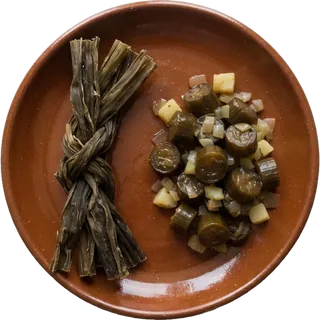
The peeled stalk of the pangue, a giant-leaved plant that grows along riverbanks in the south, is eaten raw with salt and ground merkén or sliced into salad. Roadside stalls from Temuco to Chiloé sell it in bundles through spring, when the stalks are young and tender.
How to order
¿Me vende un atado de nalcas, por favor?
Nalca is sold as itself, with salt and merkén offered loose alongside, so there is nothing to clear with the seller; roadside stands along the southern highways run in Chilean Spanish, so the phrase ““¿Me vende un atado de nalcas, por favor?”” needs no adjusting.
History
Nalca is the Mapudungun name for the stalk of the pangue, Gunnera tinctoria, a broad-leaved plant that grows wild along rivers and wet forest clearings from Araucanía to Chiloé; in Chilean Spanish the stalk is called nalca or pangue, the two names often used for both plant and stalk together. Mapuche families have long gathered it in spring, when new stalks push up red and tender, peeling and eating it on the spot or carrying bundles to sell at roadside stands; the plant grows across land that was Wallmapu before the Chilean state's occupation of Araucanía in the 1880s stripped most of it from Mapuche hands.
The dish is nothing but plant: pangue stalk, peeled down to the pale core, cut into sticks or strips, eaten raw with salt and often a pinch of merkén for heat. No animal product enters at any stage, in the kitchen or at the table, so there is nothing to clear with the seller beyond how much salt or chile goes on top.
Where to get it
Roadside stalls and weekend ferias along the southern highway corridor, from Villarrica and Valdivia down to Puerto Montt and Chiloé, set up through spring from September to November; a bundle of several stalks runs CLP 1,000-2,000.