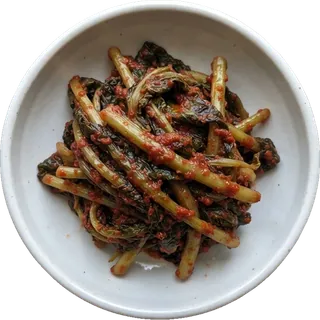
Pa-kimchi
Whole young scallions are laid flat in a thick paste of chilli powder, glutinous rice paste and garlic, then left to ferment until the white stalks turn soft and sour. It is a Jeolla-do side dish, served alongside grilled pork belly or grilled mackerel.
How to order
멸치젓 안 들어간 파김치 있어요?
Since the paste is mixed before the scallions ever meet it, a jar already fermenting cannot be remade without the anchovy sauce. Ask before buying, with “멸치젓 안 들어간 파김치 있어요?” — if the seller or kitchen has only one batch going, that may be the only kind on hand that day.
History
Pa-kimchi (파김치) is made across Jeolla-do, where thin scallions grow in the sandy coastal soil around Shinan and Haenam and are harvested young, before the stalks thicken. The scallions are washed whole, left uncut, and coated by hand in a paste of gochugaru, glutinous rice paste, garlic and sugar, then packed flat into a jar to ferment for a few days until the white base turns soft. Unlike napa cabbage kimchi, it is not part of the autumn kimjang store; it is made in small batches through spring and eaten within weeks, set out as a side dish with grilled pork belly or grilled mackerel.
The paste that coats the scallions is built on gochugaru, glutinous rice paste, garlic and sugar, but most versions add myeolchi-aekjeot, anchovy sauce, or salted shrimp to deepen the ferment; this goes in while the paste is mixed, before it ever touches the scallions, so it cannot be picked out later. There is no separate stock here, since the dish is not a soup, and no egg garnish. What decides whether a jar is plant-based is settled at the point the paste itself is made, which means asking a market seller or home cook before the jar is sealed, not after it is opened.
Where to get it
Market stalls in Gwangju's Yangdong Market and kimchi shops across Jeolla-do, and banchan plates at restaurants serving grilled pork belly or grilled mackerel in Mokpo and Gwangju; sold by the 100 g for roughly 2,000-3,000 KRW, or set out free as a side with a meal.